"The whole movement of life is learning" (Krishnamurti). "To be an act of knowing, then, the adult literacy process must engage the learners in the constant problematizing of their existential situations" (Freire). "Once you learn to read, you will be forever free" (Douglass). "I can learn anything I have the desire to learn" (White, S.G.).

Sunday, March 30, 2014

Everyone Loves a Good Story

In elementary school, I was very shy.  I rarely spoke up in class unless someone else spoke to me first, and even my interactions with my classmates were quite limited.  I am not sure why that is...perhaps it is a phase that a lot of children go through at one time or another.  However, despite my shyness, I loved to write.  Writing stories was my favorite part of class time.  Through writing I felt more confident in expressing my creativity and ideas and communicating bits and pieces of my personality to others.  Essentially, it gave me a voice and a way of making sense of the world.  Even as an adult, I often feel that I learn best through writing.  I may read something or listen to a lecture and feel that I have understood the subject matter, but I'm not really confident that I've learned something until I have written about it.  For this reason, I would agree with Rossiter and Boudin that writing can be a powerful tool for making sense of life events and for forming one's identity.  

As Rossiter mentions, "To be a person is to have a story.  More than that, it is to be a story."  People have been making sense of the world through stories and narratives for centuries.  The idea of narratives and passing down knowledge, genealogy, and national identity through stories transcends cultural barriers, ideologies, and languages.  Everyone loves a good story!  Perhaps that is why stories and narratives have survived for so long as a means of conveying knowledge and identity.  Conversely, if someone changes the story or writes against the dominant discourse, they can bring about a transformation of ideas and identities, just like the women in Boudin's Adult Basic Education class.

However, I also agree with Michelsen that the dominant discourse has taken over the traditional narrative to such an extent that it is not always effective in producing authentic self-reflection and identity formation.  Because the models of personal narratives that are taught often anticipate the process of critical reflection  and the types of epiphanies that students are supposed to reach through this process, I feel that the narratives are sometimes contrived to meet the teacher's expectations.  For example, one of the student workers from my office, an immigrant from India, was required to write a personal narrative for a writing class.  She asked me to look over it and give her feedback before she turned it in to her professor.  In her narrative, she told a touching story about how she overcame racism in her first place of employment.  When I asked her about it later, she said that she "just made it up."  It wasn't that she hadn't actually encountered racism in the workplace, but it wasn't nearly to the extent that she portrayed it in her paper.  She said that she had exaggerated the situation to make her paper more interesting for the professor, and then she "made up" some reflections about the experience because that is what she was told to include in her paper.

I think that one of the reasons that writing was so effective for the students in the novel Push was because they had the freedom to write whatever they wanted without being given expectations about the content of their work.  In this way, they really had the liberty to find their own voices and identities, by taking ownership of their own stories.

The readings this week were really interesting, and I am looking forward to talking about these complex issues in class.

Thursday, March 27, 2014

The Atlantic Says VCU Education Degree Not Worth It


Sorry to be the naysayer of the group - but The Atlantic reports that a high school graduate will earn $107,000 MORE after 20 years than a VCU graduate with an education degree (that's in-state, the number is $169,000 for out-of-state). This is not a perfect study, but it raises many questions for me... How terribly are teachers paid? Why is VCU's tuition so high? WTF are we gonna do about this?

http://www.theatlantic.com/business/archive/2014/03/these-us-colleges-and-majors-are-the-biggest-waste-of-money/359653/

Reflection on narratives

In reading this week's readings about narratives, I have a deeper understanding of a project we completed in Dr. Muth's 601 class: an educational biography. This is the second time I am reading Michelson's article about the self as text, and I'm finding myself reflective about that educational biography, and putting it into the framework of this class.

I found the educational biography project really difficult to complete.  We moved a lot when I was a kid, so I attended a huge number of schools throughout my K-12 years.  I even put off going to grad school for a really long time because I was never an awesome student until my latter years in undergrad, and even then, my confidence was not great.  Reading Boudin's article about learners in prison also struck a chord with me, as it writes a lot about poverty and situational life instability---familiar topics.  This quote resonated with me, talking about the prisoners' lack of self-confidence when it came to education:
...they brought with them negative feelings about education and about themselves as learners.  Attitudes about race, class and gender undermined their confidence to learn academically, compounding their insecurities about school. --Boudin, p215
I think I'd suggest to Dr. Muth that he add the Boudin reading to the Michelson reading for the 601 class, when discussing how to write about the narrative self.  I think the two are great companions to one another, coming from different perspectives.  I'm reflective of my educational biography project, which might look different if I wrote it today.  However, I could probably rewrite it every semester in this program and have a different perspective. That's one of the goals of this program, though, right?  Critical reflective practice?

To tie it back into digital literacy, and because I was tempted to just type a smiley face at the end of that last paragraph, I leave you with Chelsea Peretti from Brooklyn 99:


Tuesday, March 25, 2014

Banning Technology?


Preface: I'm only embedding an image so that I can show Caitlin that I'm not a complete luddite despite my not knowing what is "Pintrest" (though if I lived in the 19th century, I totally would have been!). Also, I'm a fan of Latrice Royale.

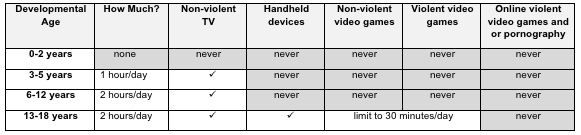
Dr. Rhodes mentioned that the Waldorf school she visited didn't allow students to use technology (until high school? - my handwritten notes were unclear ... if only I had a tape recorder ;-) which reminded me of an Huffington Post article I read. I spent at least 15 minutes in class "google jockeying," trying to find the article, but I could not. Furthermore, by the time I would have found it, the conversation had moved on. Not one to be discouraged by a failed google search, I came home and looked through my browser/browser's history (is browser an adjective modifying history or does the history belong to the browser? I could just say browsing history to simplify the matter, but where's the fun in that?). Back on March 10th - which took a while to backtrack using chrome - I found it! Below is the table and a link to the article which recommends the maximum length of time children should be exposed to technology based on age - according to several doctors, the American Academy of Pediatrics, and the Canadian Pediatric Society. This blog is either a metacognitive exercise in digital literacy or a pedantic recitation of my process to cut and paste a table. Whatcha think - about any of it?

2014-03-06-Screenshot20140306at3.29.09PM.png
http://www.huffingtonpost.com/cris-rowan/10-reasons-why-handheld-devices-should-be-banned_b_4899218.html?fb_action_ids=10100340181879657&fb_action_types=og.likes&fb_source=other_multiline&action_object_map=%5B602202916533106%5D&action_type_map=%5B%22og.likes%22%5D&action_ref_map=%5B%5D


Purposefully Developing Digital Literacy

About a month ago, a friend of mine asked me to check out some books for her from the VCU Library.  Her 13-year-old niece was working on a project on French theater, and needed some literacy criticism to include in her discussion paper.  As I got off the elevator on the fourth floor of Cabell Library, call numbers in hand, I was met by the sight of diligent students hard at work on their laptops, tablets, and other portable electronic devices.  I quietly made my way past them and into the library stacks...where I found myself...ALONE... with hundreds of old, dusty books.  I selected the 10 books that were on the list and went downstairs.  Some students in the elevator were giving me curious looks as though to say, "what is she doing with so many books?"  When I reached the circulation desk, there was a long line.  It soon became apparent to me that I was the ONLY person there to actually check out books.  Everyone else was there for renting laptops or asking a question about computer issues.  Are books slowly becoming obsolete?  Many experts think so.  In fact, I recently read a book by Nicholas Carr called The Shallows: What the Internet is Doing to our Brains (which I found VERY interesting).  But this is perhaps another topic for another time...

It is no secret that technology is all around us and (rapidly) changing every day.  Our education system is inundated with a cornucopia of digital media.  Furthermore, there is a tremendous push for educators to incorporate technology in the classroom.  This is an exciting time to work in education! But at the same time, I wonder if we are effectively teaching digital literacy.  Do students really participate in digital literacy events, or are they just learning discrete computer skills?  I think that we have come a long way in the past decade, but we still have quite a way to go. As Coiro pointed out in this week's reading, almost anyone can "access and consume information" that the digital world has to offer.  However, he goes on to say that "not everyone is equipped to build on that information in ways that generate new knowledge."  This is so very true.

In my own experience as a K-12 student, and later as an undergraduate student, I feel that I was exposed to a variety of resources, but I was essentially left to my own devices to learn how to use them effectively and meaningfully.  In my undergraduate institution, every student was required to take a content course with a "digital literacy" component.  In my case it was a Victorian Poetry class.  To satisfy the necessary requirement, the professor taught us how to search for literary criticism in JSTOR.  He did not actually teach us how to "consume" the information, but only how to look up articles on different topics, then import then into RefWorks and cite them MLA style.  Somehow, by performing this task effectively, I was suddenly deemed digitally literate by the university. 

I think that as educators, it is so important for us to continue on this journey of understanding digital literacy!

Fluency Takes Time

I enjoyed reading New Standards for Online Thinking, but it scripts a tall order for what a successful online reader-and teachers of those students-should do.  I agree with many of the points Coiro makes about developing flexible mindsets, problem-solving skills, sustained focus, etc. but I couldn’t help to think of many of the adult education students and how far removed their academia is from something like the self-regulated reading cycle described in disjuncture #3. Digital literacy will certainly play a large role in their future success but speaking as a realist, which hyperlink to click or ignore is the last of their concerns when the basics of reading and writing are at the forefront (e.g. Precious). I believe each student is completely capable of achieving all that is mentioned, it’s just getting them to hang in there long enough-along with the teachers-to develop deeper understandings of how to navigate the complexities of the online world will take time.

A take-away from the article which has morphed into my generative term for the week is fluency.  This idea about how many words are read and how many are skipped depending on the medium is interesting and something I do all the time…perhaps take for granted!  Until this reading I hadn’t thought much about how I honed skills to ignore the extraneous and became savvy enough to know what shouldn’t be clicked.

I also found Marwick and Boyd’s imagined audience intriguing.  Historically, I shy away from sharing myself on social media platforms (LinkedIn in the exception) but when I considered why I’ve done this I realized it is because of my imagined audience! Consequently, this concern with my digital identity has actually hindered my fluency with handling and navigating popular social media sites.  I guess I’m still testing how safe I consider  digital spaces to be, and a large part of that is the audience I’ve imagined...but likely isn’t!

Should be called Tweeter

I've never learned so much about twitter! Most of what I knew came from overhearing my students talk about it. I knew you could “follow” people and “retweet” “tweets” - which I think should be called “twits” but isn't for obvious reasons. I just saw it as another distraction for teenagers, something to do instead of schoolwork. I had not considered how my students were using the social media to construct ideas of themselves or how I could use their obsession with social media to enhance the teaching of literature such as an author's purpose or, especially, the intended audience. I did have students create Facebook pages for characters in an effort to jazz up/update typical character analysis, but I more like the idea of asking students questions that will put them in the place of the author and make them analyze the behaviors they are already doing. Read the word and the world, right?  

Linking back to the 1-2-3 project

Now that I have realized that the required reading link back to the 1-2-3 project, I have begun looking for the tips that will help enhance the project results. I found the following guidance in this weeks required reading…

Julie Coiro on Digital Literacies:
Good teaching is not simply adding technology to the existing teaching and content domain. Rather, the introduction of technology causes the representation of new concepts and requires developing a sensitivity to the dynamic, transactional relationship between all three components

• Connections to 1-2-3 Project: Technology can play a major factor into effectiveness of documentation and education. Many projects described in class have an online component that adds benefits and/or reduces efficiency. Considering interview questions related to technology can reveal the unspoken awareness on the process.

Alice Marwick & danah boyd "I tweet Honestly, I Tweet Passionately...
In contrast to the imagined broadcast audience, which consumes institutionally cre¬ated content with limited possibilities for feedback, the networked audience has a clear way to communicate with the speaker through the network. This opportunity for com¬munication influences how speakers respond and what content they create in the future.

• Connections to 1-2-3 Project: Consider a new audience. Our imagined audience may provide different results than the total population.


Digital Literac(ies), Digital Discourses, and Communities of Practice:
Through my observations of the writing and technology class, I came to view them as a community of practice, engaged in the project of socially constructing an understanding of digital literacy as a technological Discourse.

• Connections to 1-2-3 Project: Our work teams and environments can be considered a community of practice. Those who participate in the processes analyzed in the projects are also working to understand a discourse.

Monday, March 24, 2014

New Literacies


In Julie Coiro’s article titled Purposeful, Critical, and Flexible: New Standards for Online Thinking, Teaching and Theory” the term “new literacies research" is used.  Although the term was used at least six times in the article, I did not find its definition.   Consequently I searched the Internet for a definitive definition of the term “new literacies.”

My first stop was the “The New Literacies Research Lab” at the University of Connecticut webpage. http://www.newliteracies.uconn.edu/  Although I did not find a definitive definition, the description of their work alluded to their meaning of “new literacies.”  In particular, under the “Who We Are” banner it stated “The New Literacies Research Lab at the University of Connecticut is the most widely recognized center in the world for conducting research on the new reading comprehension and learning skills required by the Internet and other emerging information and communication technologies.”  I felt I was getting warm, but I continued my search.

My second stop was the webpage for the International Reading Association (IRA) titled “New Literacies and 21st-Century Technologies.” http://www.reading.org/general/aboutIRA/positionstatements/21stcenturyliteracies.aspx   The webpage pertains to the IRA’s position statement on the topic.  In particular, it stated “To become fully literate in today's world, students must become proficient in the new literacies of 21st-century technologies. IRA believes that literacy educators have a responsibility to integrate information and communication technologies (ICTs) into the curriculum, to prepare students for the futures they deserve.” Although this statement provided some insight about term, it did not define “new literacies,” so I continued my search by opening up the IRS's position statement pdf file.

I was happy to find the following:
There is extensive debate about what new literacies are— the term is used to mean many different things by many different people. However, there are at least four common elements that apply to nearly all of the current perspectives being used to inform the broader dimensions of new literacies research (Coiro, Knobel, Lankshear, & Leu,2008):
(1) The Internet and other ICTs require new social practices, skills, strategies, and dispositions for their effective use
(2) new literacies are central to full civic, economic, and personal participation in a global community
(3) new literacies rapidly change as defining technologies change
(4) new literacies are multiple, multimodal, and multifaceted; thus, they benefit from multiple lenses seeking to understand how to better support our students in a digital age.

Jackpot!  First, it confirmed my suspicion that this term “new literacies” has multiple meanings.  Second, it provided the common elements of these multiple meanings – the closest thing to a definitive definition.

Sunday, March 23, 2014

Authenticity and Multiplicity

I think a lot about identity and the online persona.  I'm not sure you could have social media accounts and not be aware of how others percieve you.  That sense of your perceptions of other people's perceptions of you YPOOPY thing, that social cognitive framework that we're always building.

Some things that resonated with me from this week's readings, in bullet form:

  • "transparency is so chic"
  • navigating multiplicty
  • polysemy (coded communications for different audiences)
  • friends
  • "I only tweet anything I'd say in a lobby"
  • authenticity (itself and as a social construct)
  • situationalism (people react to situations based on context)
  • audience
I guess for me, and probably for lots of people with online identities, we are all situationalists.  At work, we have one way of being, another with our friends, another still for classmates, and especially a different persona online.  That word, "polysemy" will be my generative word this week, thinking about coding our speech for different audiences.  

I have a lot of thoughts about online vs. "real life" spheres.  I think many of us are careful at work, guarded until we know we can trust like-minded folks. I think that there are a lot of ways that we utilize mutliplicity to protect our work selves when we're not in a position of power, or not in a position of financial indepence (also a position of power).  

I'm sure we'll have many different discussions about this, but I'm different at work than I am in class, and I'm different online, as well.  I think all of those differences (multiplicities) are examples of how much we are willing to let others get to know our real "authentic" selves.  Online it is easier to be the liberal activist, animal rescue, existentialist, bookish feminist, because there are more people like me online, who I follow, and who follow me---it is "safer" to be my more authentic self because of some vague anonymity and the overwhelming volume of the posts on the site on which we post.  It is easy to lose my specific signal in the noise, if that makes sense.  At work I find it's smarter to be polite and genial, and not really talk about myself, because the people at work for the most part do not share my interests.  My class self is somewhere on a continuum between the two.  

Here's a little gif set from one of my favorite TV shows (30 Rock) that speaks to both my online and my graduate student self: